SENIOR INDUSTRIAL DESIGNER


Induction Cooktop Redesign
Slim Architecture & Spill-Safe Interface for the Modern Kitchen
Industrial Design | Consumer Appliances | Product Architecture | UI/UX
Client: TTK Prestige
Context / Brief
Most portable induction cooktops are thick, visually bulky, and poorly integrated with modern kitchen countertops. Their height and dated HMI layouts reduce both usability and perceived quality, making them feel temporary rather than premium.
As kitchens evolve toward cleaner, more premium spaces, these design limitations negatively impact both usability and perceived value at the point of purchase.
This project began as a design-led pitch to Prestige, proposing a new-age induction cooktop that rethinks internal architecture, interaction, and aesthetics - positioning the product as a slim, intuitive, and visually refined countertop appliance aligned with emerging consumer expectations.
Problem Statement
Conventional portable induction cooktops are thick due to stacked internal components, making them feel intrusive on the countertop. Additionally, flat cooking surfaces place HMI controls directly in the spill zone. In Indian cooking scenarios, overflowing liquids, especially milk, often flow onto the controls, creating usability, cleaning, and safety issues.
This leads to:
-
Difficulty in interacting with controls during spills
-
Increased cleaning effort
-
Risk of burns and safety hazards
-
Reduced product longevity due to repeated exposure to HMI.
-
The interaction and aesthetic language of existing HMIs further lack the sophistication expected from modern, premium kitchen appliances.


Design Objective
To design a next-generation induction cooktop that:
-
Significantly reduces overall product thickness through internal re-architecture
-
Improves safety and usability during liquid spill scenarios
-
Introduces a refined, intuitive HMI focused on modern UI/UX principles
-
Delivers a premium, contemporary aesthetic suitable for modern kitchens
-
Supports smart features and guided cooking through digital integration

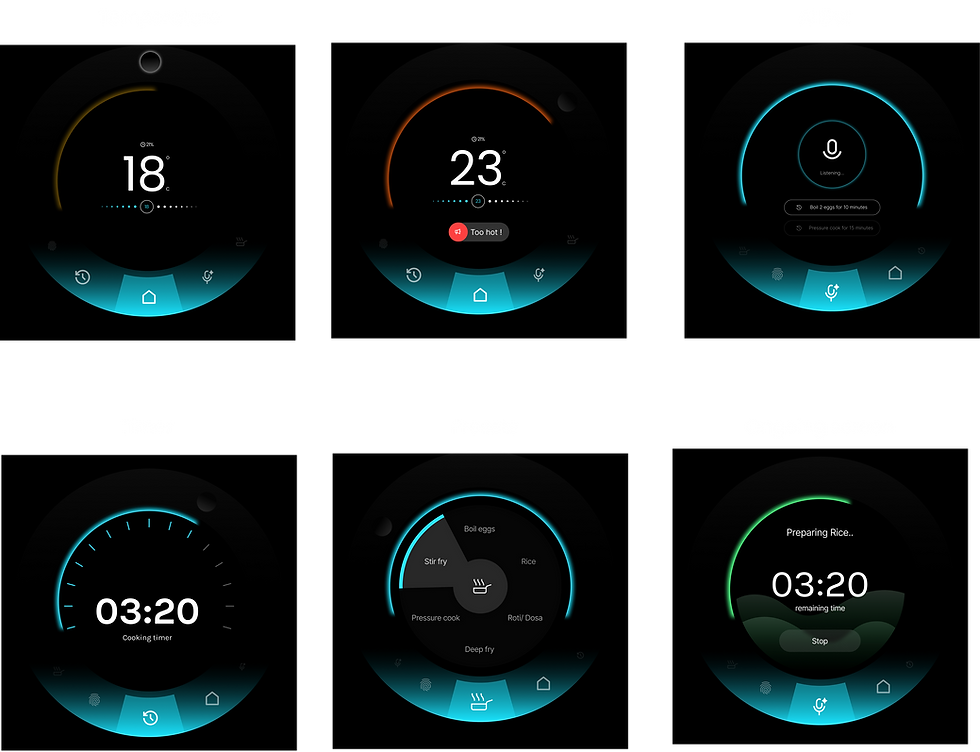
HMI - UI/UX intuitive integration

Concept Strategy
The internal layout was re-architected to reduce overall thickness, with select power components moved to an external adapter. A narrow slit above the HMI acts as a spill channel, diverting overflowing liquids away from the controls.
A circular digital interface replaces conventional buttons, enabling intuitive preset selection, temperature control, and guided cooking. App connectivity extends the experience through smart cooking support.
Outcome
-
Achieved a significantly slimmer induction cooktop through architectural redesign
-
Improved safety and usability during spill and overflow scenarios
-
Elevated interaction through a focused, intuitive circular HMI
-
Delivered a clean, premium countertop presence
-
Positioned as a modern, smart kitchen appliance aligned with evolving user expectations


